

[vc_row type=”vc_default” css=”.vc_custom_1474268037787{margin-bottom: -30px !important;padding-bottom: 30px !important;}”][vc_column offset=”vc_col-lg-12 vc_col-md-12 vc_col-xs-12″]
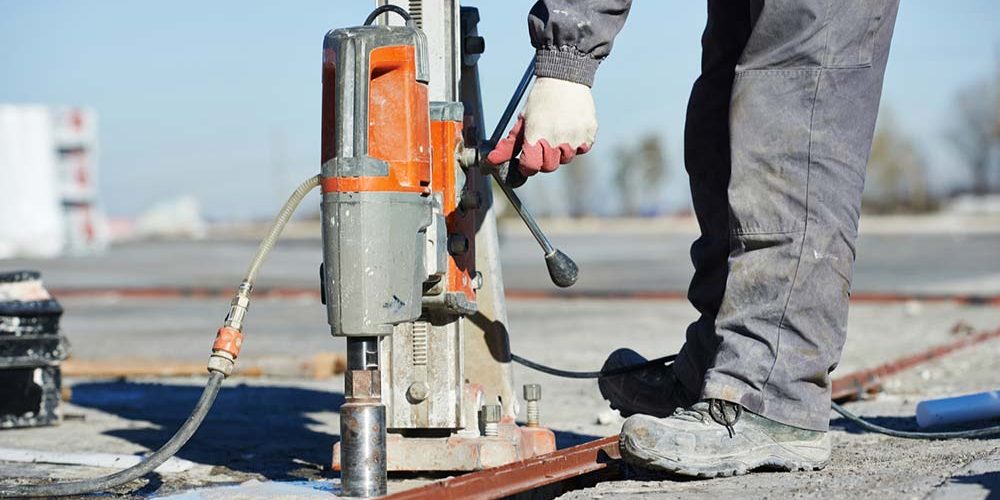
Core drilling is also used to create holes or channels for infrastructure such as ducts for plumbing, phone lines, sprinkler systems and electrical wiring.
It is the most effective method of testing concrete as it allows for an undisturbed or intact example of the material.
Core drilling is done with a core drill which is a drill specifically designed to remove a cylinder shaped piece of material. A core drill has a hollow shaft in which the material embeds as a cylinder for removal after drilling. This leaves a piece of drilled material that can be used for laboratory testing, or discarded where only the hole or duct is needed.
Metal core drills are called annular cutters and concrete core drills are usually called diamond core drills. They are water cooled.[/vc_column_text][ultimate_heading main_heading=”Additional Information” alignment=”left” spacer=”line_only” spacer_position=”bottom” line_height=”4″ line_color=”” main_heading_font_size=”desktop:26px;” main_heading_line_height=”desktop:36px;” line_width=”50″ spacer_margin=”margin-top:15px;margin-bottom:40px;” el_class=”accent-border-color” main_heading_style=”font-weight:bold;” margin_design_tab_text=””][/ultimate_heading][vc_accordion active_tab=”false” style=”2″][vc_accordion_tab title=”Advantages of Concrete Core Drilling”][vc_column_text css=”.vc_custom_1624903722711{background-color: #ffffff !important;}”]
- Faster Operation and Lower Cost
- Precision Cutting without the need of Repairs after the fact
- Little Dust and Less Debris on the Work Site
- Keeping the Structure Intact due to Low Vibration Levels
- Lower Noise Level on Site
[/vc_column_text][/vc_accordion_tab][vc_accordion_tab title=”Core Drilling Services”][vc_column_text css=”.vc_custom_1624903953534{background-color: #ffffff !important;}”]Our Core drilling services include:
- Diamond Drilling is a version of core drilling which uses a drill with a diamond drill bit.
It is used in projects which require precision drilling where hole measurement is important - Core Cutting is also known as concrete coring and it refers to the process of cutting cylinders of concrete from a structure
- Core sampling is core drilling used to extract samples of the core of the material or to create drilled holes for construction purposes. Core drilled material samples are extracted for use in testing laboratories. Laboratories need to confirm that the construction material is of the required quality, strength and durability to make it reliable for its intended use. Material sample testing is used in mining, construction and road building
- Stitch Drilling is a technique of drilling a series of overlapping holes to create a larger opening in the same way that stitches are interlinked in sewing.Stitch drilling is used when the diameter of a drill is insufficient to create the hole size needed. It is often used in the diamond mining industry where larger holes than 1,5 metres are required.This technique of drilling also allows for the boring of odd-shaped or non-standard holes. It can be used to bore a square shaped hole if needed
[/vc_column_text][/vc_accordion_tab][/vc_accordion][/vc_column][/vc_row]